
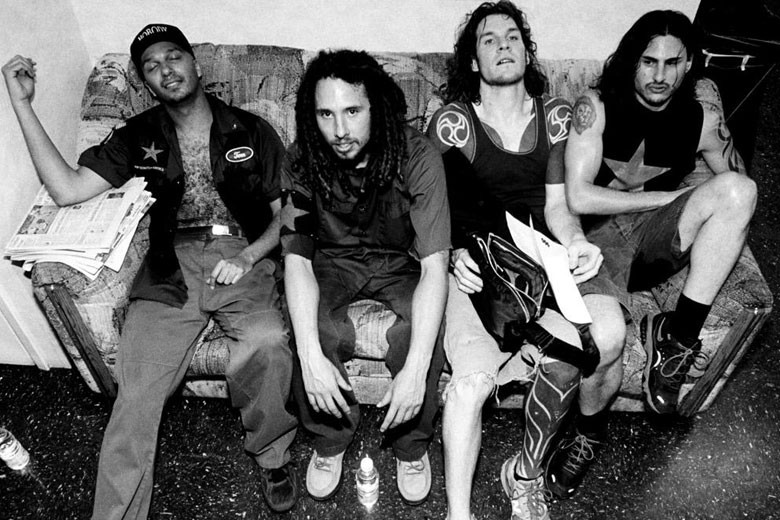
Click HERE for our RATM collection
Few bands have wielded music as a weapon of social and political protest quite like Rage Against The Machine (RATM). Combining the raw aggression of heavy metal with the rhythmic intensity of hip-hop, RATM redefined what it meant to make politically charged music. Their sound and message were built on rebellion, resistance, and revolution, making them one of the most influential bands of the Nu-Metal scene in the 1990s and early 2000s. With their hard-hitting lyrics and genre-defying sound, Rage Against The Machine helped to pave the way for socially conscious music in both rock and hip-hop, leaving a lasting legacy that continues to resonate today.
The Formation of Rage Against The Machine: Born to Protest
Rage Against The Machine was formed in Los Angeles, California, in 1991 by vocalist Zack de la Rocha, guitarist Tom Morello, bassist Tim Commerford, and drummer Brad Wilk. From the outset, the band made it clear that they weren’t just here to make music—they were here to challenge the status quo and fight against systemic oppression. RATM fused the intensity of heavy metal with the grooves and flow of rap, while Morello’s innovative guitar work brought an experimental, almost electronic feel to their sound.
The band’s name, Rage Against The Machine, reflected their opposition to "the machine"—a symbol of corporate greed, government corruption, and social injustice. Through powerful music and unflinching lyrics, RATM channeled the frustration of the disenfranchised, giving voice to the struggles of marginalized communities worldwide. Their mission was clear: fight the power with sound, activism, and an unwavering message of resistance.
Rage Against The Machine: A Groundbreaking Debut
In 1992, RATM released their self-titled debut album, Rage Against The Machine, and it immediately sent shockwaves through both the rock and hip-hop scenes. The album was a revolutionary blend of heavy metal guitar riffs, funk-inspired basslines, and hip-hop rhythms, topped off by Zack de la Rocha’s scathing, politically charged lyrics. Tracks like "Killing in the Name" and "Bombtrack" called out institutional racism, police brutality, and the greed of the ruling elite.
"Killing in the Name," in particular, became an anthem of resistance, with its now-iconic chorus, "Fuck you, I won’t do what you tell me!" The song captured the rage of a generation grappling with systemic inequality and was embraced by protest movements around the world. The power of the album didn’t just lie in its message but also in its sound. Tom Morello’s inventive guitar work, featuring unconventional techniques like feedback loops, toggle switches, and DJ-like scratching, became a signature aspect of the band’s sonic identity.
Rage Against The Machine wasn’t just an album—it was a battle cry. It laid the foundation for the band’s career and established them as one of the most important political voices in modern music.
Evil Empire: Refocusing the Political Message
In 1996, Rage Against The Machine followed up their explosive debut with Evil Empire. The album title referenced the term used by U.S. President Ronald Reagan to describe the Soviet Union, but RATM flipped the script, using the term to critique the United States’ own imperialist policies and capitalist structures.
The album’s lead single, "Bulls on Parade," took aim at the military-industrial complex, with de la Rocha’s lyrics attacking war profiteers and corporate greed. The song’s infectious groove and Morello’s wah-wah-heavy guitar solo made it an instant hit, becoming one of the band’s signature songs. Other tracks, like "Vietnow" and "People of the Sun," continued the band’s tradition of calling out injustice and oppression, with "People of the Sun" focusing on the struggles of Indigenous people in North and South America.
Evil Empire was a critical and commercial success, debuting at number one on the Billboard 200 and cementing Rage Against The Machine’s place as one of the most powerful and influential bands of the decade.
The Battle of Los Angeles: Soundtrack to a Revolution
By the time RATM released The Battle of Los Angeles in 1999, the band had fully established themselves as a global force for activism and music. The album, which debuted at number one on the Billboard charts, was a searing indictment of corporate capitalism, government corruption, and media manipulation.
Songs like "Testify" and "Guerrilla Radio" were not only musical juggernauts but also rallying cries for political resistance. "Guerrilla Radio," in particular, became a massive hit, with its hard-hitting riffs and de la Rocha’s lyrics calling for revolution: "All hell can’t stop us now." The song’s success even brought RATM to the mainstream, earning them radio play and an MTV Video Music Award.
"The Battle of Los Angeles" continued the band’s tradition of blending fiery political messages with innovative musicianship. Morello’s guitar work remained a standout, with songs like "Sleep Now in the Fire" showcasing his ability to create unconventional sounds using only his guitar and effects pedals. The album’s themes of resistance, rebellion, and social justice made it a natural fit for the growing anti-globalization movements of the late 1990s.
Notable Gigs: Defining Performances and Political Statements
Rage Against The Machine has always been more than just a band—they are activists, and their live performances often doubled as powerful political statements.
- Democratic National Convention Protest (2000) – In one of their most iconic performances, Rage Against The Machine played outside the Democratic National Convention in Los Angeles in 2000, protesting the corporate influence on U.S. politics. Their performance attracted a massive crowd of protestors, and the event was met with police intervention. The performance further solidified RATM’s reputation as a band that not only talked the talk but also walked the walk when it came to fighting injustice.
- Coachella Reunion (2007) – After disbanding in 2000, RATM reunited for a performance at Coachella in 2007, and the set became legendary. The band’s return to the stage was met with thunderous applause, and their performance was as politically charged as ever. Songs like "Killing in the Name" and "Bulls on Parade" ignited the crowd, and RATM once again proved that their music was as relevant as ever in a world still grappling with the issues they had long been fighting against.
- Finsbury Park Free Concert (2010) – Following a successful campaign to get "Killing in the Name" to the top of the UK charts as an anti-X Factor protest, Rage Against The Machine played a free concert at Finsbury Park in London. The performance was a celebration of grassroots activism and the power of music to mobilize people against corporate interests.
Band Members and Their Political Passion
Rage Against The Machine’s music is driven by the individual passions and talents of its members, each of whom brings something unique to the band’s sound and message.
- Zack de la Rocha, the band’s lead vocalist and lyricist, has been a tireless advocate for social justice since the band’s inception. His lyrics draw inspiration from revolutionary figures like Che Guevara and Malcolm X, and his explosive stage presence has made him one of the most powerful voices in political music.
- Tom Morello, the band’s innovative guitarist, is equally passionate about activism. Morello is known for his creative approach to the guitar, using effects pedals and unconventional techniques to create sounds that mimic turntables and electronic instruments. Outside of RATM, Morello has continued his activism with projects like The Nightwatchman and Prophets of Rage, as well as the hard-rock supergroup, Audioslave. He remains one of the most outspoken political voices in music.
- Tim Commerford, bassist, and Brad Wilk, drummer, provide the backbone of RATM’s sound. Their tight, groove-heavy rhythm section is a crucial part of the band’s ability to blend hip-hop and metal seamlessly. Both have been involved in various music projects outside of RATM, linking up with Tom Morello for Audioslave and Prophets of Rage.
RATM’s Hiatus and Reunion: The Revolution Continues
Rage Against The Machine went on hiatus in 2000, with its members pursuing different musical projects. Zack de la Rocha focused on solo work and activism, while Morello, Commerford, and Wilk formed Audioslave with Chris Cornell of Soundgarden. However, the band’s message of resistance remained more relevant than ever, and in 2007, RATM reunited to headline Coachella.
Since then, the band has played several high-profile shows, including their politically charged performance at Finsbury Park in 2010. In 2020, Rage Against The Machine announced a full-scale reunion tour, although plans were delayed due to the COVID-19 pandemic. Nevertheless, the band's return to the stage promises to reignite the revolutionary energy that has always been at the heart of their music.
Rage Against The Machine’s Legacy: Music as a Weapon
Rage Against The Machine’s fusion of rap, metal, and political activism has made them one of the most important bands in modern music. Their ability to tackle complex social and political issues with uncompromising intensity has inspired generations of musicians and activists. As the world continues to grapple with issues of inequality, government corruption, and corporate greed, RATM’s music remains a vital force for change.
At Eyesore Merch, we honour Rage Against The Machine’s legacy with official merchandise that celebrates their revolutionary spirit. Whether you’ve been a fan since their debut or have recently discovered their music, our RATM collection is the perfect way to show your support for one of the most influential bands in rock history. Explore our exclusive designs today and earn Eye Points as you shop, keeping the spirit of rebellion alive with Eyesore Merch!